Oscillator attention.
An attention mechanism implemented as the relaxation of a coupled oscillator network. Anchor positions break the multi-equilibrium structure of generic Kuramoto dynamics and produce a single attracting equilibrium per query. That structural property is what makes attention deterministic and trainable on this substrate.
Read the paper on arXiv →Transactions on Machine Learning Research · arXiv:2606.12059 · Provisional patent filed
Unique equilibrium per query.
Generic Kuramoto-style networks admit many equilibria. For some computations this multiplicity is the point: associative memory exploits exponentially many stable phase-locked configurations; Ising-machine optimizers encode combinatorial solutions as distinct fixed points; general oscillator neural networks draw on the same richness. For attention, however, multiple equilibria would be a bug: the same query in the same context could produce different attention patterns depending on initialization, breaking determinism.
The fixed-query design removes the ambiguity. Anchors, the orange squares in the video above, are external forcing terms rather than free oscillators, so each free oscillator evolves independently of the others: it descends a potential set by the weighted anchor sum alone. On the sphere that flow has exactly two equilibria — the settled state, which is the closed-form normalized anchor sum, and its antipode. The settled state is asymptotically stable and the antipode is unstable, so every trajectory that does not start exactly on the antipode converges to the same point. Attractivity is almost-global rather than global, and that distinction is the honest one: the exception is a single point, but it is not empty.
This matters because the guarantee is what transfers to hardware. It holds for every physical realization of the flow, which is what justifies training on the algebraic fixed point and then deploying the physics. In software the settled state is computed in closed form, so the two ways finite-time convergence can fail — a near-cancelling anchor sum, or an initialization near the antipode — bear on physical deployment only, and both are controlled by the oscillator dimension.
The video below makes the property visible. One query, three random initial conditions for the active oscillator, one settled state. The three colored trails fan out across the unit circle and funnel into a single point. The attention row and the candidate-probability bars, both read out from the settled state, collapse onto the same values whichever trail was taken.
Where this sits in the Kuramoto-AI literature.
Kuramoto-style networks have been explored for a range of AI computations. Oscillator-based associative memory exploits coupled-oscillator multistability to store exponentially many patterns [Ogranovich et al., 2026]. Charge-density-wave oscillator networks solve combinatorial optimization problems by mapping them to arrays whose settled phase configurations encode solutions [Brown et al., Phys. Rev. Applied 2025]. AKOrN-style oscillator neural networks use Kuramoto dynamics as a general representation primitive, with oscillators that couple to one another inside a digital forward pass [Miyato et al., ICLR 2025]. These lines exploit the rich multi-equilibrium structure of generic Kuramoto dynamics. Attention is different: it requires a unique attracting equilibrium per query. Free oscillators here do not couple to one another at all — they align independently to fixed anchor forcing, and that is what yields both the closed-form fixed point and the convergence guarantee.
Same dynamics, three substrates.
The architecture is defined at the level of the dynamics, not the hardware. Any physical system supporting coupled phase variables can in principle realize attention by relaxation. Each panel below has a peer-reviewed Kuramoto reduction in the literature; the citations are there to show this is not a metaphor. Charge-density-wave arrays are a fourth such substrate, and one we have built on directly [Brown et al., Phys. Rev. Applied 2025].
Parity at minimal hardware; a measured gap on language modeling.
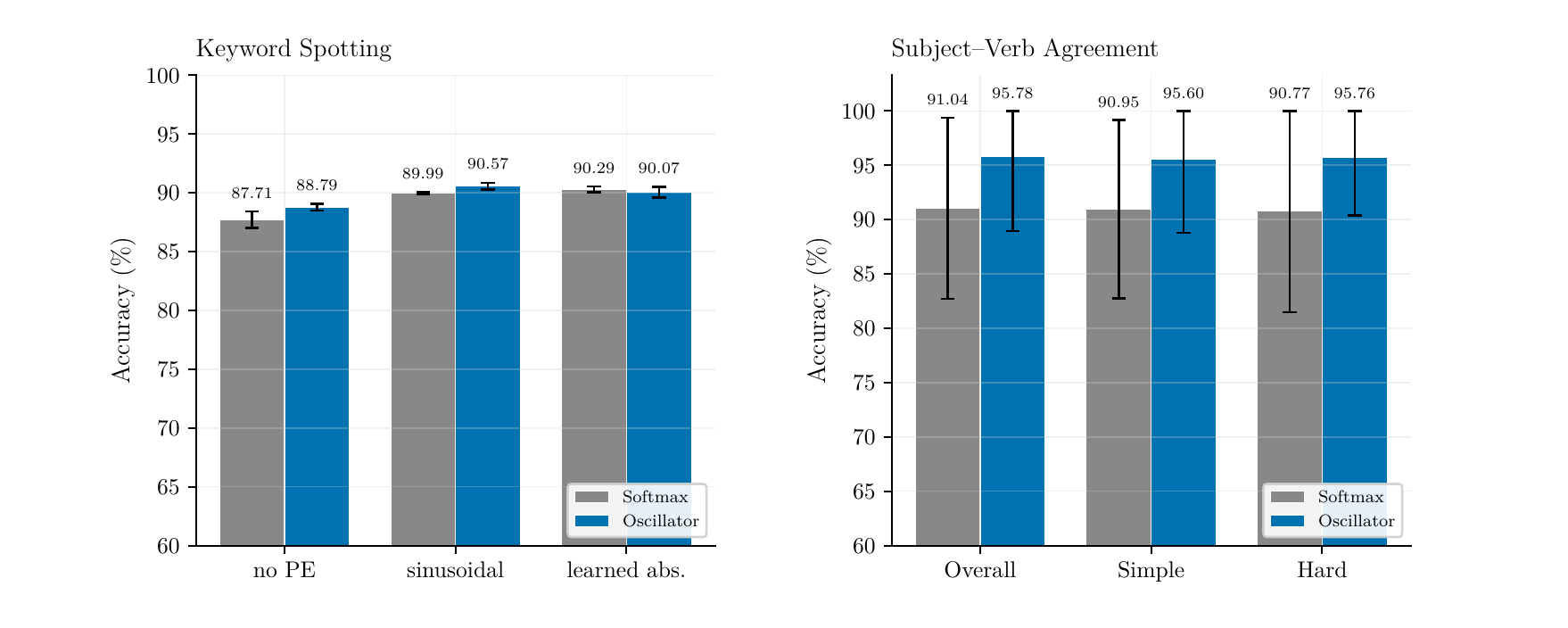
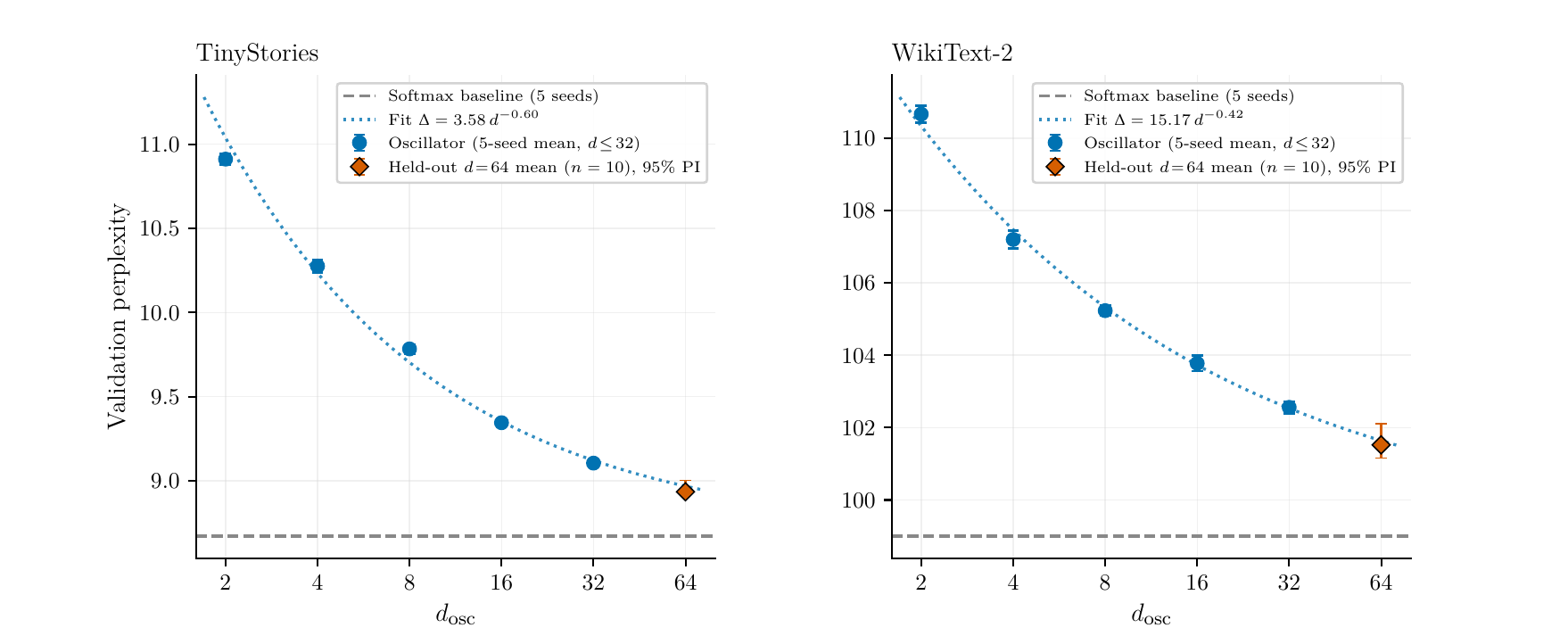
The objective is not to replace softmax in software. It is to show that a mechanism a physical oscillator array can execute is accurate enough to be worth building, so softmax is used as a calibration baseline rather than a target to beat. We evaluate on keyword spotting (KWS), subject-verb agreement (SVA), and causal language modeling (TinyStories and WikiText-2).
At the minimal hardware configuration — oscillator dimension d_osc = 2 — the two mechanisms are at parity on both bidirectional tasks. On KWS the comparison has to be made under matched positional information: the anchors are learned per absolute position, so they act as a built-in positional encoding of standard strength, and an oscillator model compared against a baseline with no positional encoding is being flattered by that. Under matched encoding the two land within a few tenths of a point of each other. On SVA the accuracies also match; what differs is reliability. Training runs that fail outright are markedly rarer for the oscillator, 3 seeds in 50 against 12 in 50 for softmax, which is where the wide error bars in the right-hand panel come from.
Causal language modeling is the harder setting, and softmax retains a real advantage there. The useful result is that the gap is not stubborn: it decays as a power law in the oscillator dimension, and the fitted relation predicts a configuration it was never shown. Fits over d_osc from 2 to 32 were used to forecast d_osc = 64; the held-out runs land inside the 95% prediction interval on both datasets. The dimension of the substrate, not the mechanism, is what bounds accuracy here.
The people behind the work.
- PI · Professor of EECS, UC Irvine · Director, UCI Robotarium
- Taosha GuoPh.D. student, EECS · Co-author
Selected references.
- Pasqualetti, F. & Guo, T. (2026). Attention by Synchronization in Coupled Oscillator Networks. Transactions on Machine Learning Research.
- Ogranovich, A., Guo, T., Venkatakrishnan, A. R., Shapiro, M. R., Bullo, F. & Pasqualetti, F. (2026). Oscillator-Based Associative Memory with Exponential Capacity: Theory, Algorithms, and Hardware Implementation. IEEE Transactions on Control of Network Systems (submitted).
- Brown, J. O., Guo, T., Pasqualetti, F. & Balandin, A. A. (2025). Charge-Density-Wave Oscillator Networks for Solving Combinatorial Optimization Problems. Physical Review Applied 24(2), 024040.
- Miyato, T., Löwe, S., Geiger, A. & Welling, M. (2025). Artificial Kuramoto Oscillatory Neurons. International Conference on Learning Representations 2025.
- Lohe, M. A. (2009). Non-Abelian Kuramoto models and synchronization. Journal of Physics A 42(39), 395101.
- Wiesenfeld, K., Colet, P. & Strogatz, S. H. (1998). Frequency locking in Josephson arrays: connection with the Kuramoto model. Physical Review E 57(2), 1563–1569.
- Pantaleone, J. (2002). Synchronization of metronomes. American Journal of Physics 70(10), 992–1000.
- Pikovsky, A., Rosenblum, M. & Kurths, J. (2001). Synchronization: a universal concept in nonlinear sciences. Cambridge University Press.
- Kuramoto, Y. (1975). Self-entrainment of a population of coupled non-linear oscillators. International Symposium on Mathematical Problems in Theoretical Physics.
- Fries, P. (2005). A mechanism for cognitive dynamics: neuronal communication through neuronal coherence. Trends in Cognitive Sciences 9(10), 474–480.